

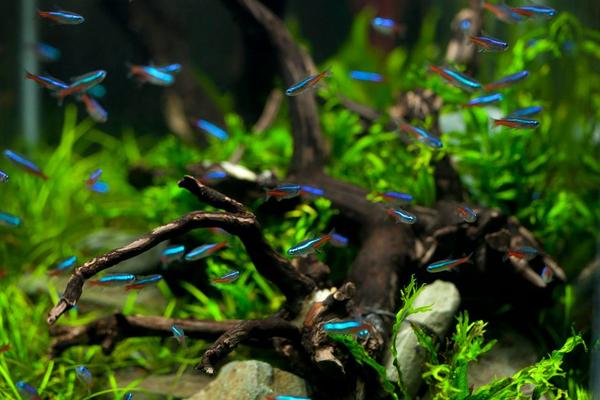
Neon tetras are tiny fish with an outsized presence. A group moving through green plants can turn an ordinary aquarium into a lively display of blue and red. Yet their small size creates a misleading impression: they are not fish to scatter individually into any new tank. Successful neon tetra care starts with a properly sized group, stable water, and a layout that lets these shy fish feel secure.
The species, Paracheirodon innesi, comes from South American streams and usually grows to about 1.2–1.5 inches (3–4 cm). It suits peaceful freshwater aquariums, but a mature setup matters far more than flashy decorations.
Start With the School, Not a Single Fish
A tetra school size of eight to ten or more neons is a sensible starting point. Six is sometimes described as a minimum, but a larger group generally makes them more confident. When neons feel exposed, they may hide, lose some colour, or behave nervously. Familiar companions encourage natural movement.
Do not expect a perfectly synchronized formation all day. Comfortable fish often spread out to explore and regroup when something startles them. Constant frantic darting, clamped fins, or individuals hiding alone deserve closer attention.
For example, if you have space for ten neons or five neons plus several unrelated fish, choose the larger neon group first. A full school is usually a better use of limited stocking capacity than an assorted collection of single fish.
Choosing the Right Neon Tetra Tank Size
Swimming length matters alongside water volume. For a small group, aim for an aquarium with a footprint of at least roughly 24 by 12 inches (60 by 30 cm), commonly around 14–15 US gallons depending on tank height. A 20-gallon long aquarium offers even more useful horizontal space and greater stability.
You may see ten gallons recommended as a minimum. However, compact tanks leave less margin for water-quality problems and fewer opportunities to create sheltered and open areas. Beginners will often find a roomier aquarium easier to manage.
A ten-fish school in a planted 20-gallon tank leaves more flexibility than the same group packed beside several other schools. Check adult sizes, filtration, and swimming levels before adding companions. Small fish still produce waste and need space.
Neon Tetra Water Parameters That Actually Matter
Neons generally do well in soft to moderately soft, slightly acidic to neutral freshwater. For ordinary captive-bred fish, a practical target is 70–77°F (21–25°C), a pH around 6.0–7.0, and low to moderate hardness. They tolerate some variation, but abrupt changes are risky.
Resist adjusting pH daily to chase an exact number. A steady, suitable reading is usually preferable to a constantly changing one. If your tap water is very hard or alkaline, research a safe long-term water-mixing approach instead of relying on quick chemical fixes.
Cycle the Aquarium Before Introducing Neons
An established biological filter converts toxic ammonia to nitrite and then to nitrate. Both ammonia and nitrite should read zero on a reliable aquarium test before fish are introduced. Check these regularly when the aquarium is new or after unexpected behaviour.
Manage nitrate through water changes, plants, and sensible feeding. Keeping it low, ideally below about 20 ppm, is a useful routine target rather than a substitute for testing other compounds. For a step-by-step setup, see our freshwater aquarium nitrogen cycle guide.
Make the Tank Feel Like a Safe Stream
Neons often show their best colours against dark substrate with leafy plants, wood, and shaded areas. Leave an open corridor along the front or centre so the school can swim without weaving constantly through obstacles. Floating plants can soften harsh lighting, but should not block all light for rooted plants.
A gentle, consistent filter flow is preferable to a powerful jet that pushes the fish around. Use a heater if room conditions cannot hold a stable temperature, fit a secure lid, and treat replacement tap water with a suitable dechlorinator.
They do not require tea-coloured water or an elaborate imitation of the Amazon. Clean, stable conditions and a sense of cover are the essentials. Our guide to easy freshwater aquarium plants can help with a simple low-light layout.
What to Feed Neon Tetras
Neons are small omnivores with small mouths. A quality micro-pellet or finely crushed tropical flake can form the staple diet. Rotate in appropriately sized frozen or live foods, such as daphnia or brine shrimp, for variety. Large chunks may be ignored simply because the fish cannot swallow them.
Feed small portions once or twice daily, offering only what the group can finish promptly. Watch individuals at feeding time: timid fish may miss food if faster tank mates dominate the surface. Uneaten food collecting on the bottom means portions are too large.
Choose Peaceful Tetra Tank Mates
Good companions have similar water requirements, peaceful temperaments, and mouths too small to swallow adult neons. Small Corydoras catfish and some gentle rasboras can work where aquarium size, temperature, and each species’ own group requirements are met. Shrimp may coexist, although tiny shrimplets can be eaten.
Avoid large predators and persistent fin-nippers. Adult angelfish may eat neons even when both species seemed compatible while young. Also be cautious with fish that need distinctly harder, warmer, or faster-flowing water. Our peaceful community fish compatibility guide can help you compare candidates.
Acclimation, Maintenance, and Warning Signs
Buy active fish with full bodies, clear eyes, intact fins, and consistent swimming. Avoid tanks containing visibly sick or dying stock. Quarantining newcomers in an established separate setup can reduce the chance of introducing disease.
When bringing fish home, dim the lights, gradually acclimate them to the destination water using an appropriate method, and avoid pouring shop water into the tank. Test water regularly and replace roughly 20–30% weekly as a starting routine, adjusting to measured conditions and stocking. Match replacement water temperature and treat chlorine or chloramine before adding it.
Watch for persistent fading, abnormal swimming, wasting, white spots, or isolation. These symptoms can have several causes, including poor water quality and infection. So-called neon tetra disease is serious, but appearance alone is not enough to diagnose it. Check water tests first and seek aquatic veterinary guidance when illness is suspected rather than dosing medication at random.
Neon Tetra Care FAQs
Can neon tetras live in a five-gallon tank?
A five-gallon aquarium is too restrictive for a healthy long-term school. Choose a larger tank with adequate swimming length and water volume instead.
How many neon tetras should be kept together?
Plan for at least eight to ten where possible. Larger groups usually display more natural social behaviour, provided the aquarium can comfortably support them.
Do neon tetras need a heater?
They need stable, suitable water temperature. In homes where aquarium water falls below their preferred range or fluctuates, a thermostat-controlled heater is the reliable choice.
Build Around Their Needs
The most attractive neon aquarium is rarely the busiest one. Give the fish a generous school, horizontal swimming room, sheltered planting, modest feeding, and consistently clean water. With those basics handled, their brilliant colour and relaxed, coordinated movement become the reward rather than something you have to chase.