

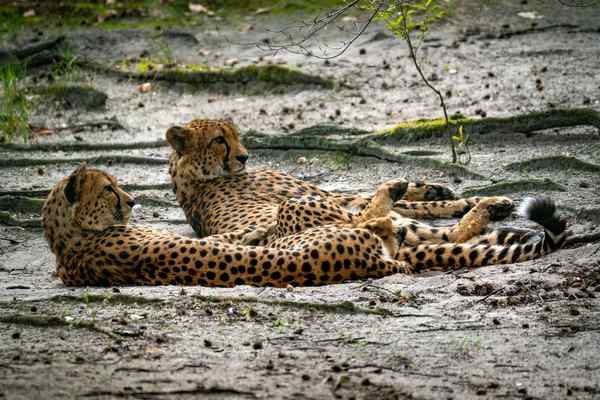
A spotted cat appears through the grass. Is it a cheetah or a leopard? At a glance, their golden coats can look surprisingly similar, but a closer look reveals predators built for different lives. The cheetah is a specialist sprinter; the leopard is a powerful, adaptable stalker. Knowing where to look—face, coat, body shape, and behavior—usually settles the cheetah vs leopard question faster than judging size alone.
Cheetah vs Leopard: The Quick Differences
For fast identification, start with four clues. A cheetah has solid black spots, dark tear lines beneath its eyes, a slim frame, and long legs. A leopard has rosette-shaped markings, no prominent cheetah-style tear lines, a broader head, and a more muscular body.
Behavior provides another hint. A cat accelerating across open ground after a gazelle is likely a cheetah. One moving quietly through dense cover or resting on a branch may be a leopard. Neither clue is absolute: cheetahs also stalk before running, and leopards use open habitats.
Spots and Facial Markings: The Easiest Field Clues
Cheetah Spots Are Mostly Solid
A cheetah’s coat is scattered with separate, dark, round or oval spots. Look closely and most markings appear filled in rather than forming rings. The pattern helps conceal the cat among dry vegetation, despite its reputation for hunting in open country.
The face is even more distinctive. Black lines run from the inner corners of the eyes toward the mouth, giving the impression of dark tears. These are among the most reliable identification features, especially in photographs showing only the head.
Leopard Spots Form Rosettes
Leopard spots often group into irregular, flower-like rings called rosettes, with lighter fur inside. On the face and legs, some markings are solid spots, so check the shoulders and flanks before deciding. A leopard’s face generally looks broader, without the cheetah’s long black tear streaks.
A black leopard, sometimes called a black panther, still has a patterned coat, although its rosettes can be difficult to see against dark fur.
Body Shape: Runner Versus Climber
Cheetahs look almost greyhound-like: narrow waist, deep chest, relatively small head, and long legs. Their lightweight build and flexible spine support explosive acceleration and extended strides. The tail helps balance sudden turns, while partly retractable claws improve traction.
Leopards are compact and muscular, with powerful shoulders, thick limbs, and strong jaws. Their retractable claws help grip prey and climb. A leopard’s body is built to wrestle, carry, and maneuver rather than maximize straight-line speed.
Size overlaps by age and sex, so shape and markings are better clues than weight.
How Fast Is a Cheetah Compared With a Leopard?
Cheetah speed is extraordinary, but headline figures need context. Cheetahs are widely described as capable of roughly 60 to 70 miles per hour (97 to 113 kilometers per hour) in exceptional short bursts. They cannot sustain that pace, and speeds in real hunts vary with terrain, prey, and tight turns.
The secret is not just top speed. A cheetah accelerates rapidly, extends its body through a flexible spine, and uses its long tail to help steer as prey changes direction. It must end a chase quickly because sprinting is physically demanding.
Leopards can also run fast over short distances, but cannot match a cheetah in an open sprint. Their advantage comes from approaching unnoticed and striking at close range. This big cat comparison highlights two solutions to the same challenge: speed and strength.
Hunting Style: Chase or Ambush?
How Cheetahs Hunt
A cheetah spots prey using keen eyesight, creeps closer, then launches a brief chase. Gazelles and other small to medium-sized antelopes are common targets. After catching an animal, the cheetah usually brings it down and uses a throat hold to subdue it.
Cheetahs often hunt during daylight, including cooler morning and late-afternoon hours. They face another problem after a successful chase: stronger predators, including lions and hyenas, may steal their kill. Avoiding a fight can be safer than defending dinner.
How Leopards Hunt
Leopards rely on stealth. They move through cover, wait for the right moment, and pounce from close range. Their prey ranges from small mammals to antelope and other animals, depending on local availability.
A leopard may drag its catch into a tree, keeping it beyond the reach of many scavengers. Not every leopard stores food in branches, but this is a memorable clue to its strength. Leopards are often active at night, although they also hunt during daylight.
Climbing, Social Behavior, and Habitat
Leopards are excellent climbers and use trees for resting, watching, and protecting food. Cheetahs can climb onto low trunks or termite mounds for a better view, but are not adapted for hauling heavy prey high into branches.
Both cats are generally solitary hunters, with exceptions. Female cheetahs raise cubs alone, while some males form coalitions, often with brothers. Adult leopards typically live alone except during mating and when females care for cubs.
Cheetahs live mainly in parts of Africa, particularly eastern and southern regions, with a tiny, critically endangered Asiatic population in Iran. They often favor areas with room to spot and pursue prey, including grassland and open woodland.
Leopards range across parts of Africa and Asia and tolerate diverse environments, from savannas and forests to rocky landscapes. Habitat alone cannot identify a spotted cat, but location can narrow the possibilities.
A Practical Way to Identify One on Safari
Imagine seeing a cat lying in the shade at midday. First, examine its face through binoculars: obvious black tear lines suggest a cheetah. If the face is obscured, look at the torso. Solid spots and a slim, long-legged outline favor cheetah; rosettes and heavy shoulders favor leopard.
Watch without approaching or disturbing it. A cat carrying prey up a tree strongly suggests a leopard. One scanning open grassland from a termite mound could be a cheetah, although behavior alone is not proof. Understanding African savanna animals, big cat hunting strategies, and animal camouflage can add useful context to a sighting.
Frequently Asked Questions
Are cheetahs and leopards the same species?
No. The cheetah is Acinonyx jubatus, while the leopard is Panthera pardus. Both belong to the cat family, but they are distinct species with different hunting adaptations.
Which is stronger, a cheetah or a leopard?
Leopards are generally more robust and stronger for grappling, climbing, and carrying prey. Cheetahs sacrifice some power for acceleration and agility during short pursuits.
Can cheetahs climb trees like leopards?
Not in the same way. Cheetahs may get onto low or sloping trunks, but leopards are much more capable climbers and may carry kills into trees.
Which cat has tear marks and which has rosettes?
The cheetah has distinctive black tear marks running down its face and mainly solid body spots. The leopard lacks those long facial lines and displays rosettes across much of its body.
Conclusion
The clearest cheetah leopard differences are visible before either animal moves: tear lines and solid spots point to a cheetah; rosettes and a sturdy frame point to a leopard. Their movements explain the rest. One is shaped by speed and pursuit, the other by stealth, strength, and climbing. Learn those connections, and the two spotted cats become harder to confuse.