

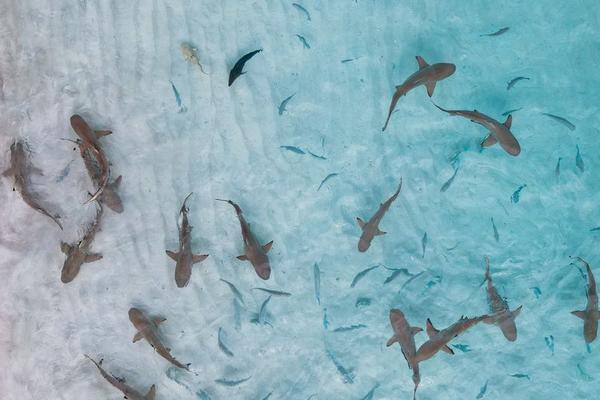
A shark sighting can feel surprising until you look at the ocean around it. Water warms, baitfish gather, currents shift, and sharks respond. Shark migration patterns reflect a changing relationship with food, suitable habitat, and the seasons. Some sharks travel across ocean basins; others make shorter journeys along coastlines or between shallow and deep water.
Understanding why sharks travel helps explain why a species appears regularly in one region, disappears for months, and returns the following year. Two populations of the same species may even follow different schedules.
What Counts as Shark Migration?
Migration generally means a recurring, directional movement between habitats, often linked to seasonal conditions or a stage of life. It differs from everyday hunting within a home range. There is no universal shark migration calendar, and individuals do not always follow identical routes.
Some migratory sharks move north and south with the seasons. Others travel from coastal feeding grounds to offshore waters or return to nursery areas. Sharks also move vertically through the water column, although a daily dive is not necessarily a migration.
Why Do Sharks Migrate?
Temperature Changes Their Habitat
Water temperature influences metabolism, prey distribution, and where many sharks can spend time. As coastal seas cool in autumn, some species move towards warmer areas or deeper water. When temperatures rise, suitable habitat may expand northwards or southwards, depending on the hemisphere.
Temperature is not an automatic switch. White sharks retain heat in parts of their bodies and tolerate cooler conditions than many tropical species. Sudden cold spells can also prompt movement outside the usual seasonal pattern.
Food Moves, So Predators Follow
Shark movement often overlaps with prey concentrations. Schooling fish gather along currents or in productive coastal waters. Plankton-feeding whale sharks visit rich feeding areas, while larger predatory sharks may spend time near marine mammal colonies.
That does not mean every shark simply chases its food. Some repeatedly visit familiar feeding areas; others exploit short-lived opportunities. Temperature, currents, and food availability all influence the route.
Breeding and Nursery Areas Matter
Migration can connect feeding grounds with places used for mating or giving birth. Shallow bays, estuaries, and coastal lagoons shelter young sharks of certain species. Adults may visit these habitats, while juveniles remain until they begin ranging farther.
Lemon sharks, for example, use shallow coastal nursery areas. This helps explain why protecting one bay can matter to sharks that spend other parts of their lives elsewhere.
Currents Shape the Journey
Ocean fronts, currents, oxygen levels, and changing productivity can influence where sharks swim. Currents may concentrate prey, while temperature boundaries mark the edge of preferred habitat. Because these conditions vary, a familiar corridor will not always be used in precisely the same way.
How Migration Patterns Differ Among Species
Atlantic Blacktip Sharks: Coastal Seasonal Movement
Along the western Atlantic coast, blacktip sharks offer a visible example of seasonal shark patterns. Many move towards warmer Florida waters in winter and north along the coast during spring. Their movements are associated with seasonal conditions and access to feeding habitat.
Imagine observing a Florida beach in February and again in July. A change in the number of passing blacktips does not necessarily mean the population has grown or collapsed. You may be seeing different stages of a recurring coastal journey. Location and season matter as much as a single sighting.
White Sharks: Coastal and Offshore Journeys
White sharks demonstrate how complex migration can be. In the northeastern Pacific, tagged adults travel between California coastal waters and offshore Pacific areas. In the northwestern Atlantic, tracked white sharks use different habitats across a broad coastline and offshore waters.
Routes vary by population, age, and individual. A map of one journey is fascinating but cannot stand for every white shark. Comparing great white shark habitats across regions offers a fuller picture than a single tracking line.
Whale Sharks: Productive Waters and Feeding Gatherings
Whale sharks are enormous filter feeders whose movements often overlap with productive waters. In the northern Gulf of Mexico, researchers have documented seasonal gatherings around shelf-edge habitats during summer and autumn, as well as individuals using more distant offshore areas.
Popular feeding sites account for many sightings, but they do not reveal every destination. Tagged whale sharks take different routes, and scientists still have gaps in their knowledge of where some individuals travel.
How Do Sharks Navigate?
Researchers are investigating how sharks find their way across long distances. Experiments with bonnethead sharks suggest sensitivity to Earth’s magnetic field may help orientation. Smell and other environmental cues could also contribute, depending on the situation.
Returning to a familiar coastline shows impressive orientation, but it does not prove exactly which senses guided the animal. Scientists cannot assume every shark species navigates identically.
How Scientists Track Shark Migration
Scientists combine satellite-linked tags, acoustic tags, sightings, and environmental data. Satellite tags can reveal broad movements, while acoustic tags register when sharks pass underwater listening stations. Researchers then compare these records with water temperature, prey patterns, and other conditions.
Every technique has limits. Acoustic receivers work only within detection range; satellite tracks can contain gaps. A handful of tagged sharks cannot represent an entire population. If you follow an online shark-tracking map, compare several sharks across multiple seasons before declaring a route typical. Regional guides to sharks in Florida waters can add useful context.
Why Migration Routes Matter
Sharks may cross fishing zones and national boundaries on a single journey. Research helps identify feeding grounds, nursery habitats, and the corridors connecting them. Protecting one site without understanding the full route may leave other essential habitats exposed.
Warming seas and shifting prey distributions could also change where some sharks travel. Long-term monitoring is needed to separate persistent changes from normal year-to-year variation in shark movement.
Frequently Asked Questions
Do All Sharks Migrate?
No. Some make long-distance journeys, while others stay relatively close to a home range. Individuals within a migratory species can also travel different distances.
What Time of Year Do Sharks Migrate?
There is no worldwide migration season. Timing depends on species and region. Atlantic blacktips commonly move towards Florida in winter and northwards again in spring.
How Far Can Migratory Sharks Travel?
Distances range from short coastal movements to journeys of thousands of kilometres. Some tracked white sharks cross vast stretches of ocean, but distance alone does not reveal why they travelled.
Do Sharks Return to the Same Places?
Some do. Researchers have documented repeated visits to feeding grounds and coastal nursery regions. This tendency, called site fidelity, varies by species and life stage.
What the Journey Reveals
Shark migration patterns reveal an ocean in motion. Temperature, food, reproduction, and currents shape where these animals spend different parts of the year. The most useful question is not simply where a shark went, but what conditions made that destination valuable.
Looking at Atlantic blacktips, white sharks, and whale sharks side by side shows why regional knowledge matters: each responds to different opportunities in the sea.