

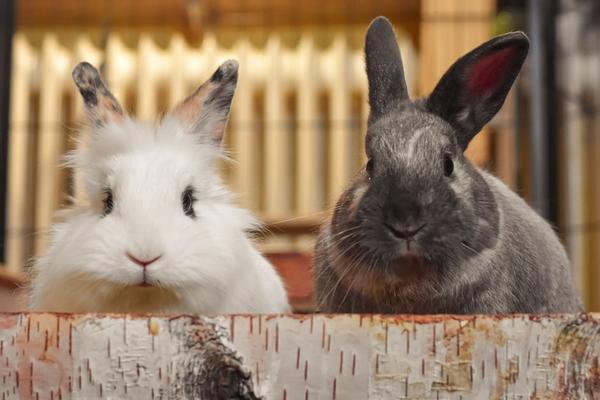
A rabbit does not need a tiny “bedroom” with occasional exercise. It needs a living area large enough to move naturally every day. The traditional small-hutch setup can leave too little room to run, stretch, explore, or stand fully upright.
For two medium-sized rabbits, major welfare guidance such as the RSPCA and Rabbit Welfare Association & Fund recommends a single living area of at least 3 metres by 2 metres, with a height of 1 metre. That space should include shelter and exercise space, with permanent access rather than a small hutch that opens only for short play sessions. Bigger rabbits need more room, and any setup should be judged by what the rabbits can actually do inside it.
Why a hutch alone is not enough
A hutch can still have a role, but it works best as a sheltered sleeping and resting area inside a much larger enclosure. Rabbits are active animals and need enough horizontal floor space to hop repeatedly, run, change direction, stretch out, forage, and perform energetic jumps known as binkies.
This is why rabbit hutch size should not be treated as the whole housing calculation. A tall two-storey hutch may look spacious, yet stacked levels do not replace an open footprint where a rabbit can run. Platforms and tunnels are useful enrichment, but they are additions to usable floor area rather than substitutes for it.
How much indoor rabbit space should you provide?
For a bonded pair of average-sized rabbits, a practical benchmark is an enclosure with a footprint of at least 3 metres by 2 metres and a height of 1 metre. This gives about 6 square metres of floor area. The enclosure can be a rabbit-proofed room or a large, secure pen system.
For one rabbit, there is no simple rule that says you can halve those dimensions. A single rabbit still needs room to run and perform the same natural movements. Rabbits are also social animals, so many welfare organisations recommend compatible companionship rather than planning permanent solitary housing unless there is a specific welfare or veterinary reason.
Test the space from the rabbit’s point of view. Your rabbit should be able to stand upright without its ears touching the top, lie fully stretched in any direction, turn comfortably, make several consecutive hops, and move between resting, eating, toileting, and activity areas without being squeezed around equipment.
A rabbit exercise pen should be living space, not a bonus
An exercise pen is one of the easiest ways to create generous indoor rabbit space. Instead of closing the rabbit into a small cage overnight and opening a pen for only a few hours, make the larger pen the normal home base. Place the litter tray, hay, water, hides, chew items, and resting area inside it, and keep the space accessible day and night where possible.
Additional supervised free-roam time in a rabbit-proofed room is still valuable. The key is that roaming should enhance a good home setup rather than compensate for an enclosure that is too small for the remaining hours.
A practical living-room example
Imagine a rabbit kept in a 120-centimetre cage that opens into the living room for three hours each evening. The rabbit may exercise during those hours, but it still spends most of the day confined. A better arrangement is to surround the cage with a large rabbit exercise pen and leave the cage door open. The cage becomes a retreat, while the pen becomes the true living area. Supervised access beyond the pen can add variety.
Do not overlook rabbit proofing
More freedom only works when the area is safe. Electrical cords are a major hazard because rabbits can bite through them quickly. Effective rabbit proofing means enclosing cords in durable protective covers or blocking access completely. Check houseplants for toxicity, close gaps where a rabbit could become trapped, and keep unsafe household items out of reach.
Flooring matters too. Rabbits can struggle on slippery laminate, polished wood, or tile. Rugs or washable non-slip mats can help them move confidently, while exposed wire flooring should be avoided. Give the rabbit places to hide as well as open space; a good enclosure provides security and choice, not just empty square footage.
How to tell if your rabbit needs more room
Measurements provide a useful baseline, but the usable layout matters. If litter trays, hides, bowls, and toys fill so much of the enclosure that the rabbit cannot move freely, the stated dimensions are misleading. The same applies when a pen is divided into narrow corridors.
Prioritise an open, continuous floor area first, then place enrichment around the edges and rotate items instead of overcrowding the centre. A rabbit should be able to run, explore, stretch, rest in different locations, and interact with enrichment without constantly bumping into barriers.
Does free-roam living remove the need for an enclosure?
A fully rabbit-proofed room or home can provide excellent space, but rabbits still benefit from a familiar base containing litter, hay, water, hiding places, and a quiet resting area. This gives them a secure retreat and makes temporary confinement easier when cleaning, visitors, or household hazards require it.
Free roaming also does not eliminate regular safety checks. Rabbits can find a newly exposed charger cable, squeeze behind furniture, or reach a plant that was previously inaccessible. Recheck the environment whenever furniture or household routines change.
FAQ
What is the minimum space for two medium-sized rabbits?
A widely used welfare recommendation is a single living area of at least 3 metres by 2 metres and 1 metre high for two medium-sized rabbits. The shelter and exercise area should be connected and available at all times.
Can a rabbit live in a hutch if it gets daily exercise?
A small hutch should not be the rabbit’s main living space. Daily exercise is helpful, but the rabbit should also have enough room to move naturally during the many hours when you are not actively supervising it.
How much free-roam time does a rabbit need?
There is no single number that fixes inadequate housing. The better approach is a large permanent living area plus additional safe roaming opportunities. If your rabbit spends time in a pen, make that pen generous enough for normal movement at all times.
Does a larger rabbit need more space?
Yes. A large breed should be able to stand upright, stretch fully, hop repeatedly, and turn freely without touching barriers or having its movement blocked by furnishings. More rabbits also require more space.
Give your rabbit a home, not just a container
The most useful way to answer how much space a rabbit needs is to stop thinking in terms of the smallest cage that can hold one. Start with enough continuous floor area for real movement, include a secure shelter, and make exercise space part of the permanent setup. For two medium-sized rabbits, 3 metres by 2 metres by 1 metre is a strong welfare benchmark; larger rabbits and larger groups need more.
A spacious habitat makes enrichment easier too. Once there is room to run, hide, forage, rest, and explore, toys and free-roam sessions become additions to a good environment rather than attempts to make up for a cramped one.