

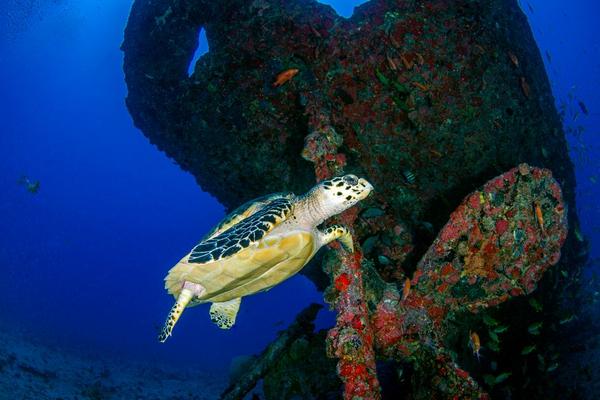
A sea turtle can leave a beach as a hatchling, cross open ocean and, years later, return to a familiar coastline to breed. There are no landmarks across most of that journey, and currents can push the animal off course. So how do sea turtles navigate? Research points to a layered system: they sense Earth’s magnetic field, respond to waves and light, and remember information about places they visit. Different cues become useful at different stages of life.
Navigation Changes as Turtles Grow
A hatchling needs to reach deeper water quickly. A juvenile must find food. An adult female may travel between feeding grounds and the region where she hatched. Sea turtle navigation therefore involves several different problems rather than one perfect instinct.
Scientists distinguish between knowing which direction to swim and recognizing approximately where you are. This difference helps explain why sea turtles use magnetic information as both a compass and a map. Much of the experimental evidence comes from loggerheads, though several sea turtle species undertake long migrations.
The First Journey: Light and Waves
Finding the Water From the Beach
When hatchlings emerge, their first challenge is finding the sea. On an undeveloped beach, the open ocean horizon is generally brighter than the darker silhouette of dunes and vegetation. Hatchlings move toward that horizon, usually reaching the surf.
Artificial lights can interfere with this response. A bright hotel, streetlight or beachfront property may draw young turtles inland instead. Disoriented hatchlings face exhaustion, dehydration, vehicles and predators. Coastal light is a useful cue only when it points in the right direction.
Swimming Against Incoming Waves
After entering the surf, hatchlings can use wave direction to orient offshore. Waves near the coast generally travel toward land, so swimming against them helps young turtles move away from dangerous shallows. This behavior is especially valuable during their first vigorous period of swimming.
Farther out, wave patterns become less reliable indicators of where land lies. Magnetic cues then help turtles maintain appropriate headings across open water.
Earth’s Magnetic Field: Compass and Map
A Directional Compass
Earth’s magnetic field extends across the oceans. Sea turtles can detect magnetic information and use it to orient their swimming. In experiments, young loggerheads respond differently when researchers recreate fields associated with different ocean regions.
This matters during turtle migration. North Atlantic loggerheads encounter currents that can carry them across enormous distances. Magnetic cues appear to help young turtles choose headings appropriate to different parts of that ocean system, rather than simply drifting wherever water flows.
A Map of Recognizable Regions
A compass answers “Which way?” A map answers “Where am I?” The magnetic field differs geographically in strength and inclination. Together, these properties give ocean regions distinguishable signatures that turtles may use as broad positional information.
A 2025 study published in Nature found that juvenile loggerheads could learn to associate particular magnetic signatures with food. When those fields were recreated, the turtles showed anticipatory behavior without familiar visual landmarks. This supports the possibility that magnetic memory helps them recognize feeding areas. It does not mean they can locate a spot with GPS-like precision.
The researchers also found evidence that magnetic map and compass abilities may rely on different sensory mechanisms. How those senses work physically remains an open scientific question.
Currents and Experience Shape Migration Routes
Ocean currents influence sea turtle movements, particularly early in life when small turtles may be carried long distances. Yet swimming direction still matters: even modest adjustments can influence which waters a young turtle enters. As turtles grow stronger, they make more active journeys between habitats.
Many adults return repeatedly to productive feeding grounds. Learned magnetic signatures may contribute to this site fidelity, while local conditions and other sensory information probably also play roles. It would be misleading to suggest that every route is genetically fixed or identical year after year.
Imagine a turtle leaving a feeding ground for a nesting migration. Weather and currents may shift its path, but it can still arrive in the correct coastal region after making adjustments along the way. Understanding sea turtle migration routes means considering both the animal’s choices and the moving ocean around it.
How Do Sea Turtles Find Their Birthplace?
Adult females of several sea turtle species often return to nest in the general region where they hatched, sometimes decades later. This behavior is called natal homing. One leading explanation is geomagnetic imprinting: young turtles may remember the magnetic signature of their home coastline and use that information on their return.
A study of loggerhead nesting along Florida’s coastline found changes in nesting distribution consistent with shifts in Earth’s magnetic field. The patterns support geomagnetic imprinting, although they do not show exactly how an individual turtle completes every stage of the journey.
Natal homing does not guarantee a return to the precise original nest site. A female may select a suitable place along a familiar stretch of coast. Erosion, barriers and beach conditions can affect the final location. This distinction helps explain how sea turtles choose nesting beaches without overstating their accuracy.
When Navigation Cues Become Dangerous
Even a remarkable navigation system has limits. Artificial beachfront lighting can misdirect hatchlings and disturb nesting females. Coastal development changes the conditions turtles encounter near shore. Farther offshore, fishing gear and vessel strikes threaten animals regardless of how well they orient themselves.
There is a practical way to help on nesting beaches: switch off unnecessary lights, shield essential outdoor lighting and avoid using camera flashes or torches near turtles. Follow local conservation guidance, and do not carry a healthy hatchling to the sea unless authorized wildlife staff instruct you to do so. Its crawl is part of its natural journey.
Protecting darker nesting beaches complements wider work to reduce threats to sea turtles along feeding and migration routes.
Frequently Asked Questions
Do sea turtles navigate using the stars?
Magnetic, wave and coastal light cues are well supported by evidence. Navigation using individual stars has not been established as a major long-distance mechanism. Following the brighter ocean horizon is not the same as using constellations.
Can sea turtles really sense Earth’s magnetic field?
Yes. Controlled experiments show loggerheads respond to magnetic conditions. Researchers have also demonstrated learning of location-associated magnetic signatures, although the underlying biological sensors are still being studied.
Do females return to the exact beach where they hatched?
Many return to their natal region, but not necessarily the same small patch of sand. Magnetic imprinting is a leading explanation for this homing ability, potentially alongside other cues near shore.
Are sea turtles simply carried by currents?
No. Currents strongly affect their movements, especially when they are young, but turtles actively swim and orient themselves. Sea turtle navigation works within a moving ocean, not independently of it.
The Secret Is a Combination of Signals
How sea turtles navigate depends on where they are and what they need to do. Light helps hatchlings find the surf, waves guide their first offshore swim, and magnetic information supports ocean-scale orientation and recognition of familiar places. Experience adds another layer. Their astonishing journeys are possible not because they follow one invisible route, but because several senses work together.